
February 17, 2026
Echoes of a Prior Self or a Past Story— Where are we, in the here and now?
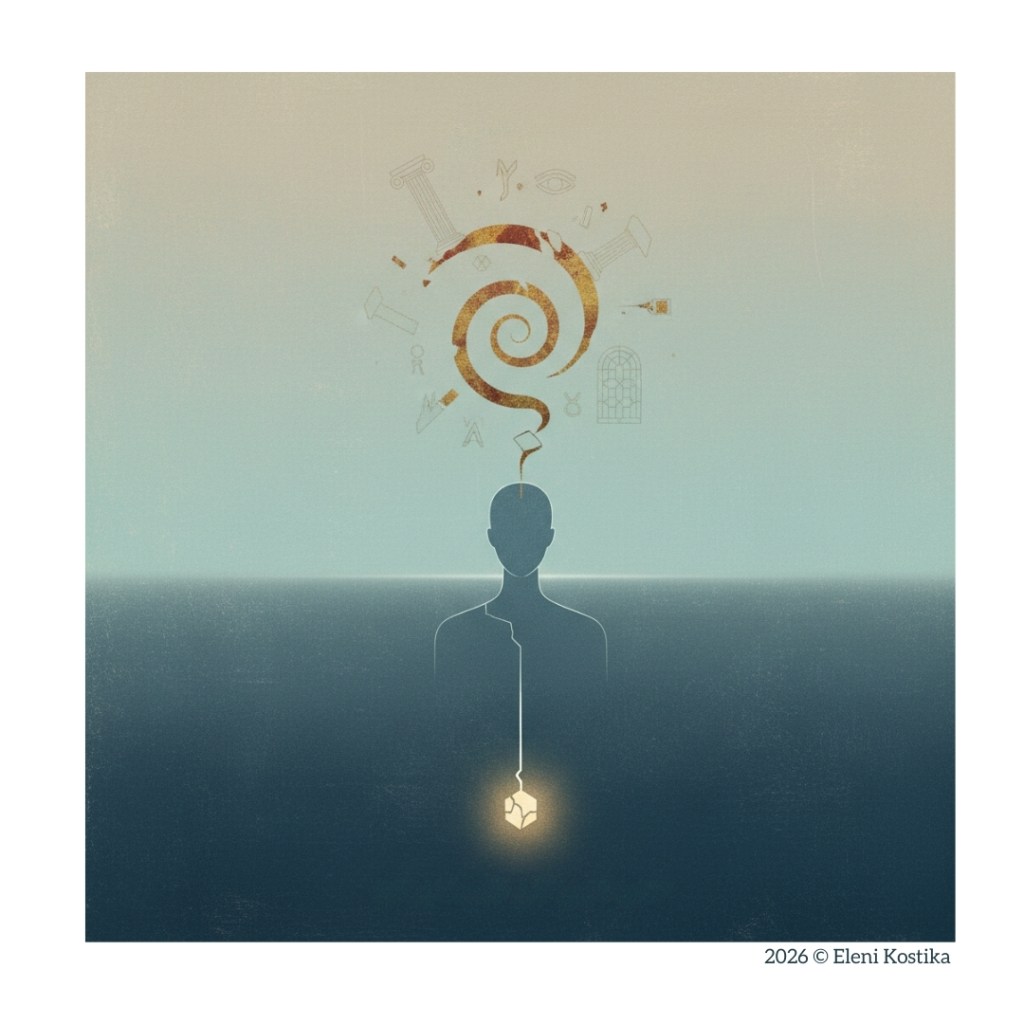
Eclipses accelerate developments and manifest events simultaneously and in parallel, where one overshadows the other. They are connected, in the political landscape, with figures of authority, or in our personal lives—if we are affected—with people who are important to us, our decisions, our profession. Solar eclipses usually revive the past, emphasize intuition, imagination, and the subconscious, and reveal aspects we were unaware of, as the invisible side of the Moon absorbs all the Solar light. They may carry fragments and memories of history, revelations. During eclipse periods, we are generally unsettled.
This is a North Node eclipse in Pisces, guiding us toward a completion or synthesis of experience that requires closing a major chapter of work or life—a way, an attitude.
The eclipse belongs to the Saros 121 cycle and is visible from Antarctica.
The annular Solar Eclipse of February 17, 2026, at 28°49′ Aquarius, and the Saturn–Neptune conjunction of February 20, 2026, at 0°45′ Aries (1st degree of Aries), open a new chapter where the old and the new coexist. Generations overlap; everything meets or merges through an ending and a new beginning. It is a moment of revelation, maturation, acceptance, transition, and the dissolution of prejudice. We are either entering a period where the personal and subjective meets the collective, unifies or merges with it. Issues of identity are a prime force.
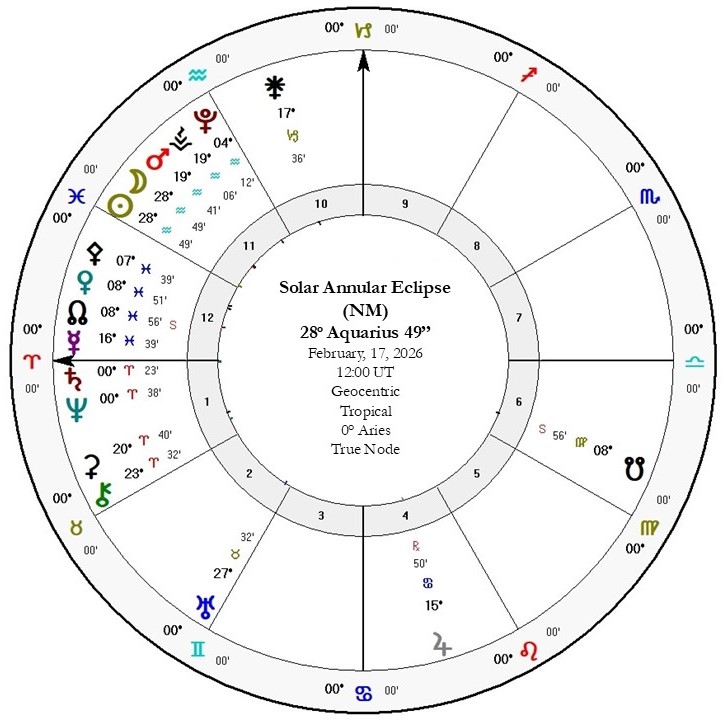
The eclipse forms a square with Uranus at 28° Taurus — an aspect of awakening, crisis, individuation, creative tension, and inner truth. Something must be released (a closing square). Upheavals and sudden events may change our habits and plans, bringing ruptures or forcing us to respond quickly. Something erupts; something must change. Somewhere we experiment. Values, groups, and networks come to the forefront.
The Saturn–Neptune conjunction near the point of the spring equinox (equal light and darkness) indicates the need to balance two energies coexisting in the same space — autonomy and independence — uniting vision and aspiration with the practical, real or experiential side of life. To deal with light and darkness simultaneously.
It aligns seriousness with faith. It tells you to step forward, to do something — a transcendence, a transition. It’s time to show something you’ve been working on for a long time without reward, or to move forward more dynamically and coherently. It’s also time to stand tall through disappointments and difficulties, to give or receive help from others, to connect through vulnerability or emotion (Venus conjunct North Node and contra-parallel Chiron). Something has completed; something has ended.
Silent Work and the Union of Two Worlds
What has been maturing for a long time begins to take shape. Sometimes, what we’ve been building quietly for years starts to come to light — not because we force it, but because it’s ready. It’s a good time to reconnect with the truest version of ourselves, the one that doesn’t need to prove anything. To materialize a plan or vision, or simply to take a new step in life. This may have various manifestations.
This doesn’t come from a need for recognition but as a natural revelation. The Saturn–Neptune conjunction at the 1st degree of Aries acts as a seed of new reality and autonomous existence. It carries a consciousness of courage and duty, or creative solitude and innovation, and at the same time a sense of sharing with the public, in a new field or context. Neptune dissolves the false; Saturn stabilizes the essential. Reflection on spiritual issues and obligations becomes important. Neptune includes; Saturn excludes. The process is slow but connected to something happening for the first time. It grounds us in the new reality in a more authentic way, through a new sense of identity.
The last Saturn–Neptune conjunction occurred in 1989 at 12° Capricorn — a year of collapse and rebirth. Ideologies, boundaries — physical, political and spiritual. What have we built since then? On February 20th, 2026, the cycle is offering a new beginning, so reflection on what has endured, what we leave behind, what solidifies, and what needs revision is potent. A crucial moment for political leaderships under pressure. Every ~37 years, this cycle reopens the question: what new vision or dream can take form? In 2026, we work on a vision — the 1° of Aries. It has an improvisational nature and says: dare a new beginning, do what you’ve long wanted, or what you instinctively feel you must do. It seeks a new model of governance and leadership, and new initiatives that unite. It marks the end of hypocrisy and illusion.
The Point of the Equinox — A New Axis of Identity
The conjunction at 1° Aries, near the point of the spring equinox, brings a restart. Something private becomes public, or something public becomes our private matter. Something personal gains collective meaning. Something must be protected and expressed. Our identity changes not only through our professional activities or what we feel we are, but also in other ways. Questions such as: “what do you identify with from now on?” may come up. We also deal with the digital era and artificial intelligence.
Saturn filters what is true; Neptune unites or dissolves what is rigid. The aspect demands faith with realism, simplicity with presence. It’s the moment when vision seeks application, even amid uncertainty.
Years ago, around 2016, I was pondering on the Saturn–Neptune conjunction in relation to the European Union, as a moment that would change the world’s mapping and geographic borders as we know them. Today, I’m not sure if that’s exactly what’s happening — though it might be — but I believe it relates to issues of asylum and migration, new regulations, and also to data control (identity issues as well) and investments in that field. This is a matter of enormous geopolitical significance, as is the concept of time and how it is appreciated, spent or consumed. The most important resource we possess is not money or skills — it is our time, where we place our attention, defines what we create and who we become.
Geopolitically, the concentration of data in a few transnational corporations creates new forms of dominance. Control over cloud systems, data centers, and satellite networks offers strategic advantages in the economy, energy, communications, defense, and artificial intelligence. Thus emerges a “digital sovereignty,” where information and time are organized and controlled by new criteria, independent of geography or physical borders. If you have a signal or leave traces of your activity online, you can be located — your identity is known. The “Digital Equinox”, and what we do in front of a monitor, is where we all meet together in the digital world. Many things may change in our shared time, in how transactions occur or markets are regulated. This process has already begun but will evolve further and differently.
Historically, every major change in time measurement (Julian calendar, Gregorian calendar, time zones) coincided with political and technological transformations and shifts in power. Similarly, today’s “digital equinox” symbolizes the transition to a world where existence, (Aries — vital space of autonomy) depends or is shaped on participation in networks and data flows.
Philosophically, the concept of the “present” is no longer shared or purely physical — it becomes multilayered and digitally mediated. Those who leave no digital trace may be seen as “absent” or “invisible.” Saturn introduces boundaries in this new reality, where access and influence are determined by one’s ability to participate and afford digital tools such as AI. Creativity and presence are concentrated — or there will be a different way to attempt to control or concentrate it.
Overall, the Saturn–Neptune conjunction in Aries represents the birth of a new era: a digital reality where time, identity, and power are reshaped through technology and information. Yet if this is the trend, we may also see users gradually withdrawing or limiting their use (Saturn is also subtractive). The possibilities are vast but not yet fully developed — though they are here to stay. Another event symbolized by this conjunction through the eclipse could be the collapse of a network or major international system or structure, prompting a complete reassessment and new regulations. Another theme involves water and oil — Neptune and Saturn in Aries — possibly sanctions or some kind of toxicity or leak.
The Eclipse and the Midpoints
The Solar Eclipse at 28°49′ Aquarius activates the Venus–Mars midpoint and forms a square with Uranus at 28° Taurus. The energy is electric, liberating, creative — activating fertility and desire — but also bringing tension, obstacles, and irritation. It calls for experimentation and letting go of what no longer works. The aspect brings sudden clarity about what has value and what does not. Relationships and values are redefined; whatever no longer fits is left behind.
Uranus awakens; the Moon reveals.
At the same time, Saturn and Neptune are at the Pluto–Uranus midpoint — a rare and powerful configuration. It indicates deep reconstruction, the need for discipline, but also mental fatigue. It can lead to rebirth or inventive solutions under difficult conditions. It connects crisis or intensity (Pluto at 5° Aquarius) and creativity and reform (Uranus at 28° Taurus) with the synthesis of a new reality that includes shared work or mutual assistance. In Aries, it comes with more instinct, physical presence, courage, innovation, and resilience.
Direction and Leadership
This period illuminates truth and integrity. Roles, systems, and organizations — international and local — based on image or false prestige are changing, shaken, or collapsing due to abuse of power, inefficiency, or lack of resources. Leadership is called to move from control to authenticity. Under pressure, it will be forced to take a stand amid greater geopolitical or ideological shifts. The question there, will be: To resign, remain neutral, or declare allegiance? In any case, this conjunction speaks of a new model of leadership — one that dares to take a stand without waiting for recognition, and that must also end confusion and vagueness, even at political cost.
Saturn demands responsibility; Neptune demands faith. The conjunction tests whether power and intention align with moral clarity. Such purification on a collective level, however, may come at a high price.
Relationships
As values and ideologies change, so do relationships. The truth and integrity of bonds are tested. The period calls for honesty and awareness. Where energy flows naturally, connection strengthens; where it is depleted, release occurs.
Liberation and New Space
Something ends naturally or inevitably, creating space and time for something new. A sense of urgency prevails. Uranus accelerates change and reform through rapid developments, while Saturn–Neptune remind us that clarity comes through awareness.
Identity and Rebirth
The 1° of Aries speaks of authentic beginnings and the courage to start again. Saturn asks for patience and structure; Neptune asks for sacrifice or space for faith, inspiration, and imagination. It reminds us not to waste time where we no longer believe. Together, they turn vision into form. They also prompt one to clear messes or misunderstandings.
The dangers of the conjunction in Aries, are fanaticism, brittleness, impatience, violence, and rigidity (hot cold) — or uncertainty, escapism, and resignation when what we believed in disappoints or collapses. This conjunction may say “Don’t give up”. We will all make a significant new beginning somewhere. Yet something must be released or accepted. Activities, professional proposals, relationships — all must weigh time, responsibility, and reward with realism.
A favorable period for collaborations with shared vision, social contribution, and creative synthesis. If something interests you, you create time to develop it. Yet any plan may dissolve if it lacks realistic vision, organization, or integrity. Events have more or less already manifested — we know or expect them — now is the time for assimilation, further processing, and dealing with external factors beyond our control, as well as exploring the new beginning. The Moon is void of course, having completed its square to Uranus and conjunction with the Sun, entering Pisces. What emerges is the need to dedicate personal time, protect privacy, and detach somewhat from usual routines — perhaps because things will unfold differently. It has both cerebral and active, reformist qualities. There is a need for care — of loved ones or self — with urgency and immediacy. We observe a tendency toward detachment from the environment, a need for independence from predetermined actions or plans. The next aspect the Moon makes is a sesquisquare to Jupiter: corrections and healing — in legal and institutional matters, health issues, friendships, and a tendency toward excess or lack of moderation with resources.
The Saros 121 Cycle and Its Historical Echoes (1900–Today)
I note here the years that this Saros cycle repeated with some mundane events of note, to unlock evolutionary themes and messages:
1917: Russian Revolution; U.S. enters World War I.
Greece: National Schism, King Constantine I leaves the country, return of Venizelos, Greece joins the war on the side of the Allies.
1935: Nuremberg Laws; Italian invasion of Ethiopia.
Greece: Abolition of the Second Hellenic Republic, restoration of the monarchy, return of King George II, The Rigged referendum on regime change, preparation for the Metaxas dictatorship.
1954: Brown v. Board of Education decision; beginning of the Civil Rights Movement; start of the Vietnam War.
Greece: Consolidation in the Western bloc, escalation of the Cyprus issue, postwar reconstruction and migration.
1972: Watergate scandal; Nixon’s resignation; SALT I agreement.
Greece: Dictatorship period, tension and repression before the Polytechnic uprising.
1990: Iraq invades Kuwait; collapse of the Soviet bloc.
Greece: Political instability, Mitsotakis government, beginning of reforms and a new era after the Cold War — restructuring of institutions and values, transition to a new economic and geopolitical framework. (The Saturn–Neptune conjunction preceded this in 1989, with the fall of the Berlin Wall and the end of the Cold War.)
2008: Collapse of Lehman Brothers; global financial crisis.
Greece: Murder of Grigoropoulos, social unrest, beginning of the economic crisis and erosion of values.
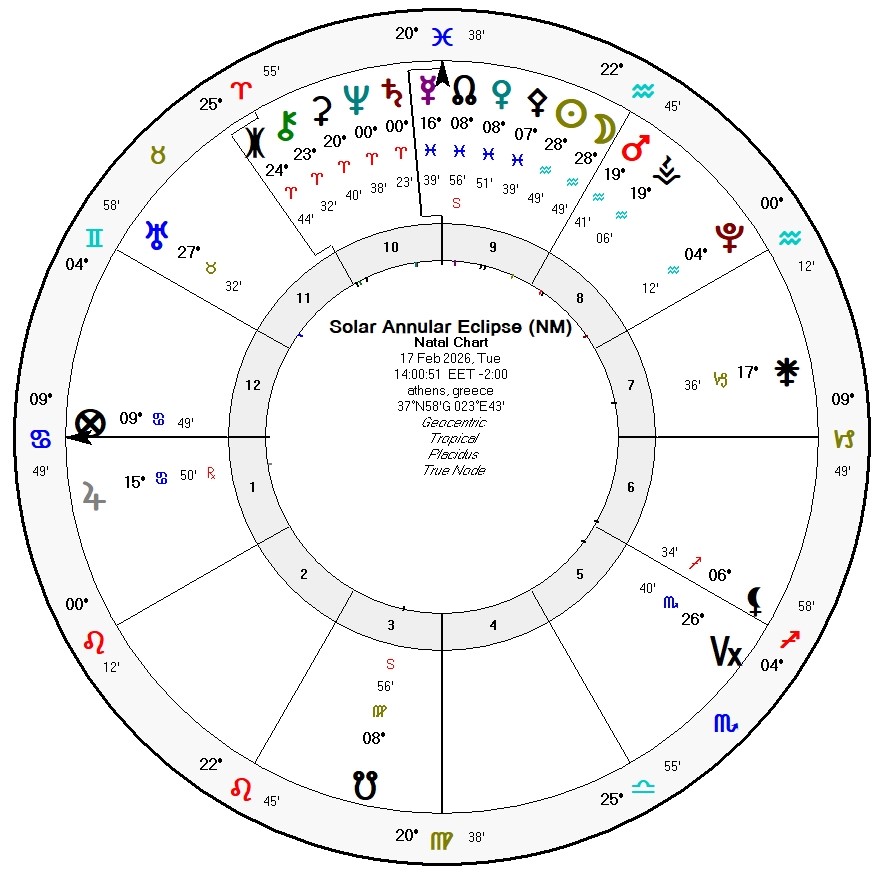
2026: The new repetition of the cycle brings issues of political instability, transparency, responsibility, and rebuilding trust to the forefront — also institutional matters. As in 1972, with the Watergate scandal and Nixon’s resignation, we see a similar theme repeating with emphasis on the U.S. and the Epstein files. The era highlights the limits of power and the need for moral clarity, the role of alliances and networks, and the management of citizens’ daily realities. A possible scenario is a referendum in Greece this year, or a dilemma about potential early elections. A Solar Eclipse often shows the leader giving power to the people — the people decide. Whether elections or referendum, it relates to political instability or controversial issues. In the chart for Athens, the Moon (ruler of the 1st house) is in the 9th house (institutional, constitutional, legal matters). While not conclusive, it suggests that critical or culminating issues may bring unexpected endings or solutions. (The eclipse occurs on Mercury in Greece’s 1830 chart, and Saturn approaches opposition to the Moon/Pluto in the post-1974 chart.) Mercury and Moon — communication with the people, negotiations, solving problems, connection with the past. We enter a new, more active political chapter as a country, with themes of control and crisis management.
We are experiencing the slow outer planets follow a sequence of entering diurnal signs from 2023–24 onward — first Pluto, then Neptune (2025–26), and Uranus (2025–26). Thus, we move into a phase where everything manifests and comes to light. This has a dynamic, potentially more into our face energy, technocratic quality — with grand urge for large scale plans, and collective changes that are more visible but also detachment from the everyday — and through changes in the new world order, more truths emerge, leading to a rawer but more realistic picture of reality. This brings potential but requires grounding — both individually and for autonomy or survival.
In Greece, the collective experience of recent decades — economic crisis, social fatigue, search for stability, erosion of values, corruption — meets, in the last few years, a greater demand for reforms, integrity and redefinition of values. This eclipse brings events that may distract from essential issues but also opens a new cycle of autonomy and political competition, which will become evident in April with the Aries stellium. More clarity may be present from July onward. The positive aspect of this era is that pretense is over (Saturn–Neptune in Aries).
We may see tensions or resignations, narrative shifts, revelations, controversies, and figures in the spotlight — a need for national cohesion or protection — and dilemmas tied to international realignments, where Greece must take a clear stance. The agricultural issue will continue in various forms, with crop problems expected this year, and perhaps in various parts of the world too. In Greece, institutional changes are also likely — in justice, spiritual authority, and reforms or agreements significant for the future. The results of this eclipse’s themes will be most visible in early October 2026, when the North Node reaches 28°49′ Aquarius.
From an archetypal perspective, this eclipse shows our need as a nation to develop a philosophy of life — our ideological lens, what we want or could become, and what is imposed upon us. Are we observers or participants in global developments? Some difficulties appear at first, or something is overturned or negated. Cancer rising, Moon ruling the Ascendant — what do we wish to protect? With this eclipse, the hidden side of Greece and its past are illuminated. You may interpret that as you wish.
Every Saturn–Neptune conjunction dissolves the old and calls for a new collective vision. The year 2026 marks a rebirth of ideals and a practical or more action oriented, expression of faith, unity, and imagination. It invites us to meet others more naturally and spontaneously — the moment calls for it. For creative or spiritual individuals who bridge the real world with their imagination or beliefs and concepts, this is a beautiful aspect: it merges parallel worlds, theories, experiences, forms of expression, talents, and more interactive and experiential mediums across different fields. For politicians, it’s somewhat controversial how they will express this energy. What is certain is that accountability, presence and stance are required.
The current themes that this eclipse comes to accelerate were already activated through the annual Sun–Uranus cycle, which speaks of something experimental — something we want to change (identity), reform, innovate — but also of imbalances and instability in decisions, or tension in values and finances within groups, friendships, and professional structures. Somewhere we leave our mark; something defines us. We can look back at these dates to see what has been activated:
May 18, 2025 – Sun–Uranus conjunction at 27–28° Taurus: first activation of themes (the last cycle in this sign for the next 77 years).
August 24, 2025 – (first quarter phase at 1° Gemini/Virgo): second wave of developments and a need for flexibility and experimentation.
November 22, 2025 – 29° Scorpio/Taurus: clarity and the need for separation through events — financial issues, shared resources, and relationships with others. Some critical matters arise around sharing, an experience is accumulated, has to reach compromise and we need to move on.
February 6–10, 2026 – Mercury & Venus on the degree of the eclipse: communication, news, ideas, contacts, and evaluations.
February 15–19 and 20, 2026 – Sun–Uranus descending square, Eclipse & Saturn–Neptune conjunction: points of unexpected changes or reforms — something must leave or be replaced, a need for release, completion, or turning point.
February 28 – Μαρτίου 01, 2026 – Mars at 28-30 degrees Aquarius (Solar Eclipse degree)
May 23, 2026 – Closing of the annual Sun–Uranus cycle at 1° Gemini: completion and change of direction, with new steps and more curiosity in new territory. More extrovert energy.
October 10–11, 2026 – North Node at 28°49′ Aquarius: manifestation of results.
Summary
This period brings revival or reflection on the past, closure of cycles, farewells, and new beginnings. It also brings upheavals, surprises, and changes of course or plans that lead to growth, experimentation, and a more autonomous way of acting or approaching life. Health matters require attention; there is support for eliminating addictions and unhealthy habits. Relationship and professional themes also need care, as do communications and impulsiveness — yet quick organization and a plan B may be beneficial. Something old completes and gains new life; something new is born — with awareness, presence, and a renewed identity. There is an emphasis on containment of leaks, the seas, or water.
The eclipse has a more personal feel for you: if your birthday falls on February 17–20, August 17–20, May 17–20, or November 17–20. If you have planets or points at 26–30° of the fixed signs, 0–2° Aries, or any of the cardinal signs. Those with planets near 28–29° Aquarius, 1° Aries, or 12° Virgo (where the upcoming total Lunar Eclipse occurs) will experience these alignments more intensely — with potential disruptions, revelations, closures, completion of work and efforts, and a push toward new beginnings.
For a personalized analysis, an individual session based on your natal chart is required.
© Eleni Kostika, 2026
 Aries Point