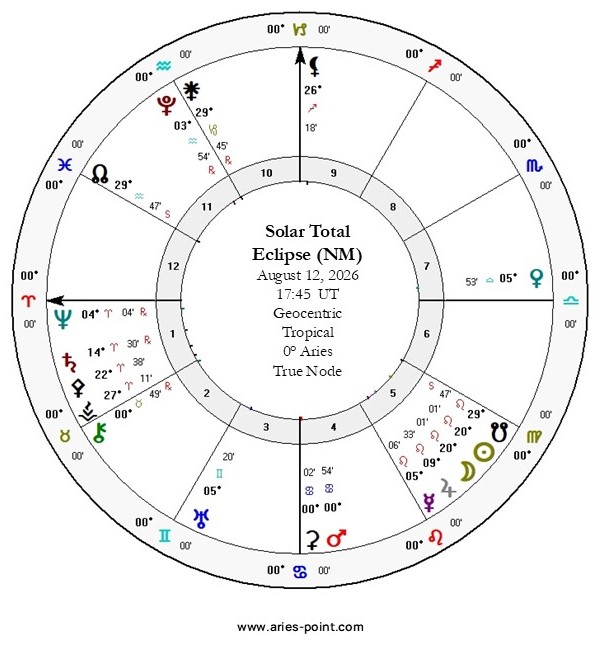
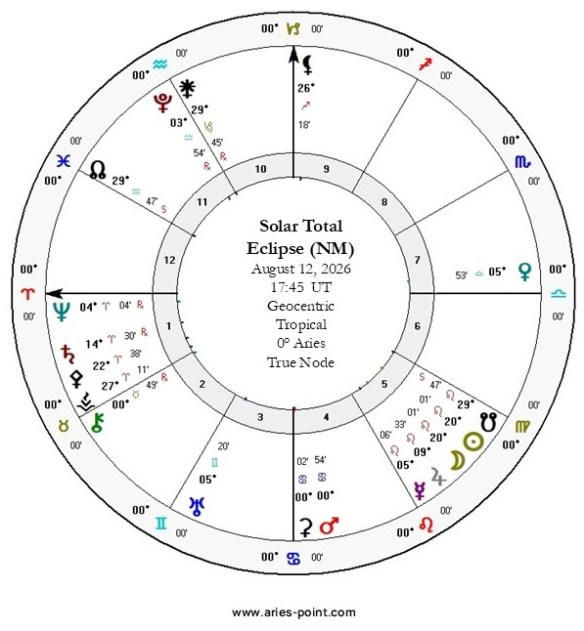
August 12, 2026, 17:45 UT
Liberation of life’s contracts, attitudes, identity, creativity, and roles.
The Total Solar Eclipse at 20°01′ of Leo belongs to the Saros 126 cycle and is a South Node eclipse.
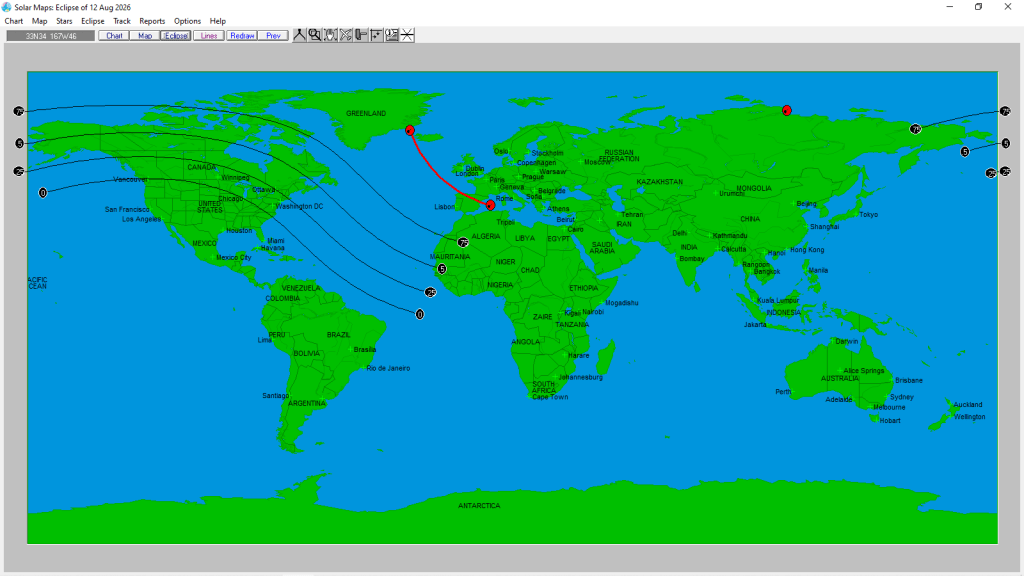
The duration of the totality phase is 2 minutes and 18 seconds.
The eclipse will not be visible from our country (Greece). It will be visible in these regions

The first eclipse of the Saros 126 cycle occurred on 10 March 1179, at 26°01′ Pisces.
This eclipse is expected to unfold its effects mainly during the period January–April 2027, with emphasis on March 14–21, 2027, when the South Node passes over this particular degree, and as Mars activates this specific degree on the following dates: November 1–5 2026 and March 28 –April 5, 2027. It is also possible that the theme of the eclipse has already been activated and is known to us, or that it will bring old issues back to the surface.
The repetitions of the cycle unlock messages and themes related to the collective level of experience, but also on an individual level insofar as our natal chart is affected:
The recent eclipses of this particular cycle occurred in: May 1900, June 1918, June 1936, June 1954, July 1972, July 1990, August 2008. Think of these periods as potent markers of what is occuring and developing in this currrent time, under different circumstances.
The influence of an eclipse, as well as the events it manifests, belong to a theme, and an area of life, that have a cyclical nature and unfold over a broader period before and after the phenomenon, recurring roughly every ~19 years. Eclipses in fixed signs carry the theme of the need for stabilization, and for permanent or long-term changes, only this one shows it may require some adjustment later. More broadly, eclipses in the signs of Leo and Cancer are of vital and central importance in our lives, since they concern signs ruled by the Luminaries (Sun–Moon -life giving forces of creation), while the opposite pole is ruled by Saturn. Therefore, from 2026–2029, fundamental areas of our life will be affected, along with the way in which our perception of creativity, lifestyle, and reality is structured and organized.
This eclipse has a more personal feel for those born August 12, November 12 , May 12, February 12 (+/- 3 days), or those who have a prenatal or postnatal eclipse in this particular Saros cycle; also if there are natal placements of personal planets or points at these specific degrees (19–21 Leo, Aquarius, Scorpio, Taurus) and by antiscia at 09 degrees Taurus. According to the astrologer Bernadette Brady, the theme of this Saros cycle, “concerns itself with breaking out of a very negative situation where no hope can be seen to a more positive space containing many options. A worry that may have been affecting the person will suddenly clear. The solution is shown by the Cosmos and needs to be taken up without too much delay” (1).
What we observe in the current chart, is the need to distinguish true action from the need to do something simply because we want validation and attention, even through a promise or through generosity.
Sun in Leo themes: Actions and Deeds, Leadership, Profession, Fame, Creations, Vitality, Children, Identity.
As the Sun is shadowed by the Moon, there is an emphasis on the Moon, which absorbs all the Sun’s light and casts its shadow onto Earth. Something ends, and along with it, a way of life, a role, a pattern of expression, which belongs to the conscious self. The revival of the past, as well as the value and stabilization of the familiar zone of life — of our personal history, is a central theme.
The emphasis on the element of Fire, and on the fixed and cardinal quality, shows us that the energy demands action, effort, a turn toward new things, together with a manifestation of ideas, concepts, and moral dilemmas. This is a creative combination, and it also seeks to bring closure to things, as well as points to how far to take things, where to resist where to let go (fixed). How our creativity, our notion of expansion, experiences, beliefs and knowledge, within a context of integration into the social fabric, networks, structures, alliances, friendships and assisting technology tools.
How much these have contributed to what we have created, but also how much they have hindered us or contributed to our development, our vision, knowledge, beliefs, support and enthusiasm, or opportunities.
Continue reading